A Good Day to Die
intimate and defiant
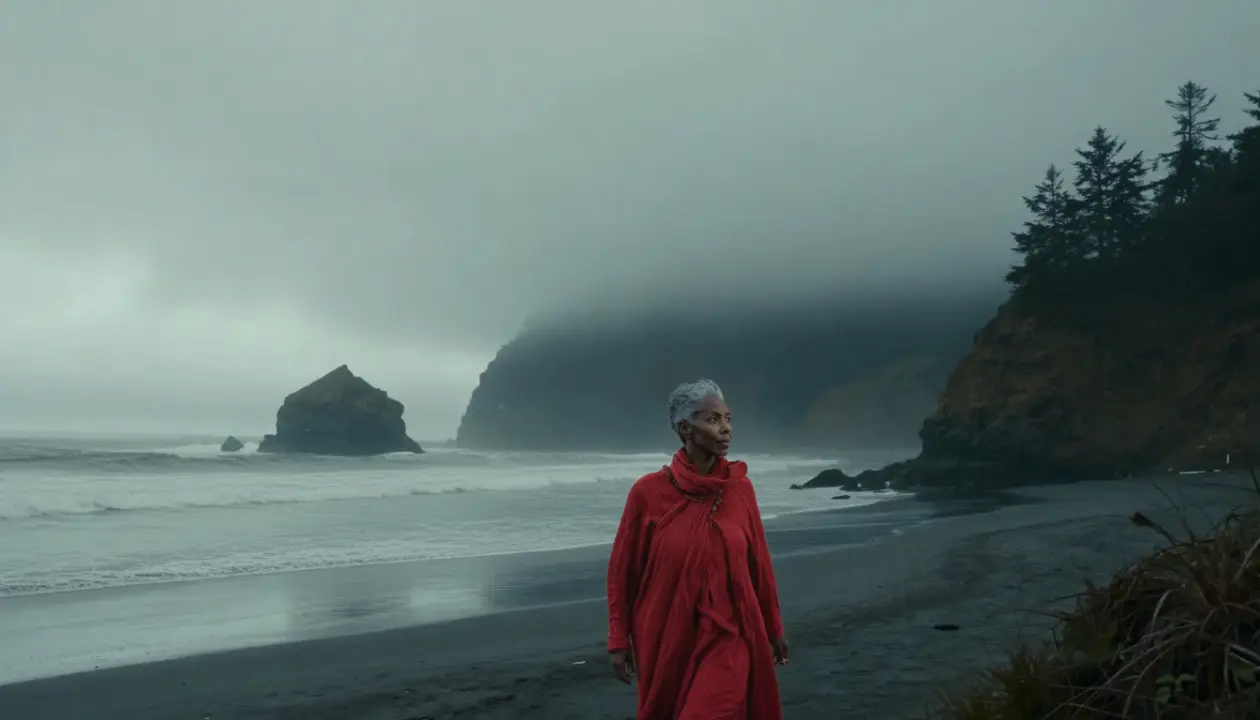
A terminally ill woman, with a lifetime of deferred ambitions, arrives at the place she's dreamed of for decades.
Story
I always thought I'd die in Atlanta. That's what I told myself anyway. Sixty-three years in that city, watching it grow up around me like kudzu on a fence post. But here I am, standing in this empty apartment on the Oregon coast. Seventy-one years old. Nine months left to live. Maybe eight. Maybe ten. I can hear the ocean through these thin walls like it's been waiting for me all along.
The moving truck left an hour ago. The driver was a young white boy with kind eyes who kept asking if I needed help bringing boxes inside. I told him no three times before he finally believed me. I'm dying, not dead. There's a difference.
I'm looking for my mother's cookbook. That's why I'm tearing through these boxes like Christmas morning. It's the one with the red cover, pages so worn you can barely read her handwriting anymore. I want my first meal in this apartment to be one of Mama's recipes. Seems right somehow. The cookbook has to be here. I packed it myself, wrapped it in newspaper like something precious, because it is.
This first box is full of shoes I haven't worn in fifteen years. Why did I bring these? My daughter Camille wanted to do the packing. She lives in Phoenix now with her husband and their two boys. She called me crazy when I told her I was moving to Oregon. "Mama," she said, "you've never even been there." Exactly, I told her. That's exactly why I'm going.
I was seven years old the first time I saw a picture of the Oregon coast. It was in a National Geographic at the Detroit Public Library, where my mama took me every Saturday while she cleaned houses in Grosse Pointe. There was a photograph of Cannon Beach with these massive rocks rising out of the ocean like God's own sculptures. Haystack Rock, the caption said. I remember thinking that was the stupidest name for something so beautiful, but I couldn't stop looking at it. I tore the page out and hid it in my underwear drawer for thirty years until the paper fell apart.
Here's my wedding album. I didn't mean to find this yet. Marcus and I got married in 1975 at Ebenezer Baptist in Atlanta. I wore my mama's dress, let out at the seams because I've always been bigger than her. Marcus looked like he'd won the lottery in these pictures. We were both twenty-three. We thought we had all the time in the world.
He died in 1998. Heart attack at fifty-one, right there at his desk at the post office. They said he probably didn't feel much. I've spent twenty-six years wondering if that's true or if that's just something people say. We were supposed to grow old together. We were supposed to take that trip to the Oregon coast we'd been planning since I showed him that magazine page on our fifth anniversary. He laughed at me but he promised. "When we retire, Loretta," he'd say. "When we retire."
Well, I retired. He didn't make it.
I'm putting this album back in the box. I'll look at it later. Maybe tomorrow. Maybe never.
The second box has kitchen stuff. Spatulas and measuring cups and a potato masher I forgot I owned. No cookbook. Underneath is a folder of Camille's school papers. First grade through high school, I kept everything. Here's her essay about what she wanted to be when she grew up. An astronaut, she wrote in wobbly cursive. She wanted to go to the moon. She became a dental hygienist instead. She's happy, I think. She says she is. But I remember that little girl who wanted to float in space, and sometimes I wonder if I should have pushed harder. If I should have told her that settling was a choice.
But who am I to talk? I worked at the DMV for forty years. I processed license renewals and registration forms and I was good at it, but it wasn't what I dreamed about when I was seven years old looking at pictures of the ocean. I dreamed about being a painter. I wanted to capture the way light moves across water, the way storms look when they're still miles offshore. I took exactly one art class at Spelman before my daddy died and I had to drop out to help Mama with the bills.
That was 1972. I was nineteen. I've been meaning to paint again for fifty-two years.
Third box. Linens. Tablecloths I used for every Thanksgiving, every Christmas, every Easter when we hosted at our house. Marcus always sat at the head of the table. Camille to his right, me to his left. After he died, I kept setting his place for three years before Camille finally told me I had to stop.
Underneath the tablecloths is a photo album I don't recognize at first. Then I open it and there's my mother, young and beautiful in 1945, wearing a factory uniform. She worked at the Ford plant during the war, making B-24 bombers. She never talked about it much. When I asked her what it was like, she'd just say, "It was work, baby. Just work." But in this picture she's smiling like she knows something the camera doesn't. Like she's part of something bigger than herself.
She died in 2003. Stroke. Quick, thank God. She was eighty-two and still living in the same house in Detroit where she raised me. I tried to get her to move to Atlanta, but she wouldn't budge. "I got roots here," she'd say. "Can't just pull up roots because you feel like it."
But you can, Mama. I'm doing it right now. I'm seventy-one years old and I'm pulling up roots because I've got nine months and I'll be damned if I spend them looking at the same walls I've been looking at since Marcus died.
Fourth box has more linens and some framed photos I took off the walls in Atlanta. Me and Marcus at Stone Mountain. Camille's high school graduation. A picture of Mama in her church hat, the purple one with the feather she wore every Easter. Still no cookbook. I'm starting to worry I left it behind somehow, that it's sitting in some donation bin at Goodwill because I wasn't paying attention.
Fifth box. This one I don't remember packing. It's full of cards. Birthday cards, anniversary cards, Christmas cards from people whose names I barely recognize. "Wishing you all the best," they say. "Hope this year brings you joy." Generic sayings from generic people having generic lives. I'm throwing this whole box away.
What I need is in the sixth box. My art supplies. I bought them two years ago when the doctor first said the word terminal. I walked out of his office, drove straight to the art store, and spent three hundred dollars on paints and brushes and canvases. Then I brought them home and never opened them. They've been sitting in this box for seven hundred and thirty days, waiting for me to be brave enough.
Well, I'm in Oregon now. I'm looking at the ocean I've been dreaming about for sixty-four years. If I'm not brave now, when?
Seventh box has books. August Wilson, James Baldwin, Octavia Butler. Words that made sense of the world when the world didn't make sense. I'm keeping these close. I might not have time to reread them all, but I need them near me like old friends.
Eighth box is photo albums. Decades of them. Here's me at five on my first day of school. Me at sixteen at my cousin's wedding. Me at thirty holding newborn Camille, looking terrified and ecstatic at the same time. Me at forty-five, fifty, sixty, at birthday parties and graduations and funerals and ordinary Tuesdays that seemed unremarkable at the time but now feel like treasures.
I looked happy in most of these pictures. Was I? I think so. I think I was happy in the way people are happy when they're not paying attention, when happiness is just the absence of suffering. But I don't think I was ever fully alive. Not the way I could have been.
Ninth box. Clothes. I'm not even going to sort through these. I lost all this weight. Whatever doesn't fit anymore, whatever I haven't worn in a year, it's all going to Goodwill. I'm not taking anything with me that doesn't serve who I am right now.
Tenth box is records. Actual vinyl because I'm old and I kept them. Aretha Franklin, Marvin Gaye, Stevie Wonder, Earth, Wind & Fire. The soundtrack of my life, pressed into a circle. I don't even have a record player anymore. Camille took it when she moved out. But I can't throw these away. I can hear them just by looking at the covers.
Eleventh box is paperwork. Taxes, insurance, medical records, a copy of the deed to the Atlanta house that I sold three months ago. The death certificate for Marcus that I've carried like I'm afraid I'll forget he died if I don't have official documentation. I'm putting this box in the closet and I'm not opening it again unless I have to.
The twelfth box. The last one. Twelve boxes. That's all it took to pack up seventy-one years. I almost don't want to open it because then the unpacking will be done and I'll have to face what comes next. My hands are shaking a little as I pull back the flaps. Inside are the blank journals I bought years ago thinking I'd write down my thoughts, my memories, my fears. I never wrote a single word. But hold on. Look. Underneath them, wrapped in newspaper, is my red cookbook.
I lift it out carefully. The newspaper falls away and there's Mama's handwriting inside the cover. Faded but you can still see it. Inside, every page is a piece of her. Collard greens. Cornbread. Sweet potato pie. Instructions written like prayers. "Don't rush the roux," she wrote next to the gumbo recipe. "Good things take time."
I'm crying now and I don't care. Let me cry. I've earned these tears.
I'm sitting on the floor holding this cookbook and I can smell my mother's kitchen. I can hear Marcus laughing at something on television. I can see Camille at seven years old, flour on her nose, learning to measure ingredients. They're all gone now. Mama, Marcus, that little girl who wanted to go to the moon. Even the woman I was when they were alive, she's gone too.
But I'm still here. For now.
I stand up. My knees crack but I don't care about that either. I carry the cookbook to the kitchen and set it on the counter. The kitchen is tiny. Much smaller than the one I had in Atlanta, but the window looks out at the ocean and the light coming through is gold and pink and orange. It's the light I've been imagining for sixty-four years.
I open the cookbook to the collard greens. Mama's notes are all over this page. "Sister Jenkins likes hers with more vinegar." "Uncle Robert can't handle too much heat." "Your daddy always wanted cornbread with these, not rice." Little details about people who are mostly gone now, saved in the margins like pressed flowers.
I read through the recipe twice. I don't have all the ingredients yet. I'll need to go to the store tomorrow. But I can see myself making this. I can see myself standing at this stove, washing greens in this sink, letting them cook low and slow the way Mama taught me. Taking my time. Not rushing.
I close the cookbook and look around at all these boxes, all this evidence of a life I've already lived. Tomorrow I'll finish unpacking. Tomorrow I'll go buy groceries. Tomorrow I'll drive to the beach and set up my easel in the parking lot at the beach. I'm going try to paint Haystack Rock the way I've been seeing it in my mind since I was seven years old. It won't be perfect. It probably won't even be good. But it will be mine.
I've spent my whole life waiting for the right time. Waiting to paint, waiting to travel, waiting to live the life I thought I'd live someday. But someday is a liar. Someday never comes unless you make it today.
I'm walking to the window now. The sun is almost down and the ocean is turning dark. I can hear the waves. I can smell the salt air. I made it here. Against my own doubts, against everyone's advice, against the ticking clock inside my body counting down to zero. I made it to the ocean.
I pick up one of the blank journals from the twelfth box. I find a pen in my purse. I write today's date at the top of the first page. And then I write: I am in Oregon. I can hear the ocean. I am alive. Tomorrow I will paint. Tomorrow I will cook Mama's greens. And today? Well, today I started living like I mean it.
I've got nine months. Maybe more. Maybe less. Either way, I'm going to fill them with more life than I've lived in the past seventy-one years.
This was the right move. This is a good place to die.